When we picture leaders in the fight against climate change, we often imagine scientists in labs, politicians at global summits, or activists marching in city streets. But if you look to the heart of rural Ghana, you’ll find the true pioneers of this movement: the farmers.
These men and women, whose livelihoods are intimately tied to the land, are not just waiting for solutions to trickle down from international conferences. They are on the front lines, innovating, adapting, and leading a quiet revolution that is healing the earth and securing their future.
The Front Lines of a Changing Climate
For generations, farming in Ghana has followed rhythms passed down through families. But those rhythms are now discordant. Unpredictable rainfall, prolonged droughts, and sudden, intense floods have become the new normal. Soil fertility is declining, and traditional harvest times are no longer reliable.
Confronted with these challenges, Ghanaian farmers could have been forgiven for despairing. Instead, they chose to act.
Seeds of Resilience: Time-Tested Techniques Meet Modern Innovation
Across the countryside, a powerful shift is taking place. Farmers are moving away from practices that degrade the land and are embracing methods that work with nature. Here’s how they’re doing it:
1. Agroforestry: Bringing the Forest Back to the Farm
Instead of clearing trees for farmland, farmers are now planting them directly among their crops. Species like the Gliricidia tree act as natural fertilizers, pulling nitrogen from the air and depositing it into the soil. They also provide shade, reduce water evaporation, and act as windbreaks. This simple practice transforms farms into diverse, resilient ecosystems.
2. No-Till Farming: Protecting the Skin of the Earth
Tilling the soil—turning it over before planting—has been a standard practice for centuries. But it also releases carbon, kills beneficial microbes, and makes the land vulnerable to erosion. Ghanaian farmers are increasingly adopting no-till methods, leaving the soil structure intact. This helps the earth retain moisture, sequester carbon, and build back its natural health.
3. Organic Composting: Gold from Waste
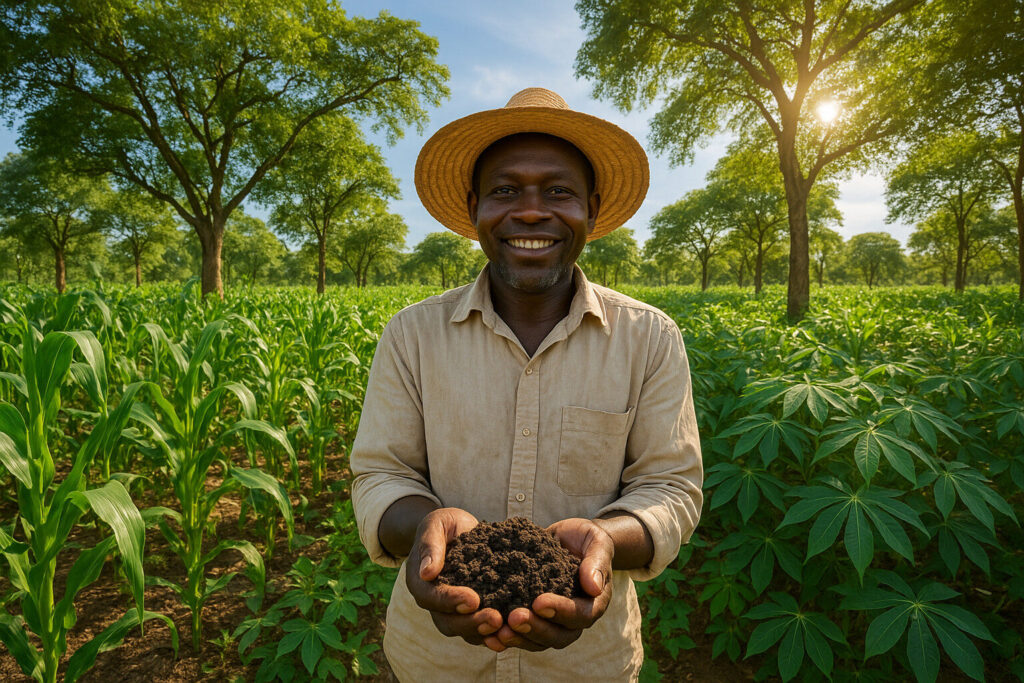
Synthetic fertilizers are expensive and can damage the soil in the long run. Farmers are returning to the roots of fertility by creating rich compost from crop residues, animal manure, and household organic waste. This “black gold” feeds the soil without chemicals, closes the waste loop, and reduces farmers’ dependence on costly inputs.
4. Crop Rotation and Diversification: Don’t Put All Your Eggs in One Basket
Monoculture—growing a single crop—is risky in a volatile climate. If that one crop fails, the entire harvest is lost. Learning from this vulnerability, farmers are diversifying. They are planting a mix of crops with different tolerances to drought and rain, and rotating them seasonally to keep the soil nutrient-rich. This not only spreads economic risk but also improves local diets.
Why Their Leadership Matters to All of Us
The actions of these rural farmers are not just local success stories; they are a masterclass in global climate action.
-
They are Carbon Sinks in Action: Techniques like agroforestry and no-till farming are powerful tools for carbon sequestration—pulling carbon dioxide out of the atmosphere and storing it in the soil and trees.
-
They Protect Biodiversity: Diverse farms become havens for insects, birds, and microorganisms, which are crucial for a healthy planet.
-
They Offer a Blueprint for Food Security: In a world facing climate-induced food shortages, these resilient agricultural models show how we can produce food without destroying the environment.
The Way Forward: Support, Don’t Patronize
The ingenuity and wisdom of these farmers are undeniable. The next step is to ensure they have the support they need to scale up their efforts. This means:
-
Direct Funding: Getting resources to grassroots farmer cooperatives.
-
Knowledge Sharing: Creating platforms for farmers to teach each other.
-
Policy Support: Developing agricultural policies that incentivize climate-smart practices.
The story of rural Ghanaian farmers is a powerful reminder that the most profound solutions are often rooted in a deep connection to the land. They are not victims of climate change; they are active, empowered agents of the solution. It’s time we all started learning from them.